APR Calculator for Fintech Loans
Calculate your actual APR including all fees. The CFPB found 41% of fintech loans hide key fees. Enter your loan details to see the true cost.
Your Results
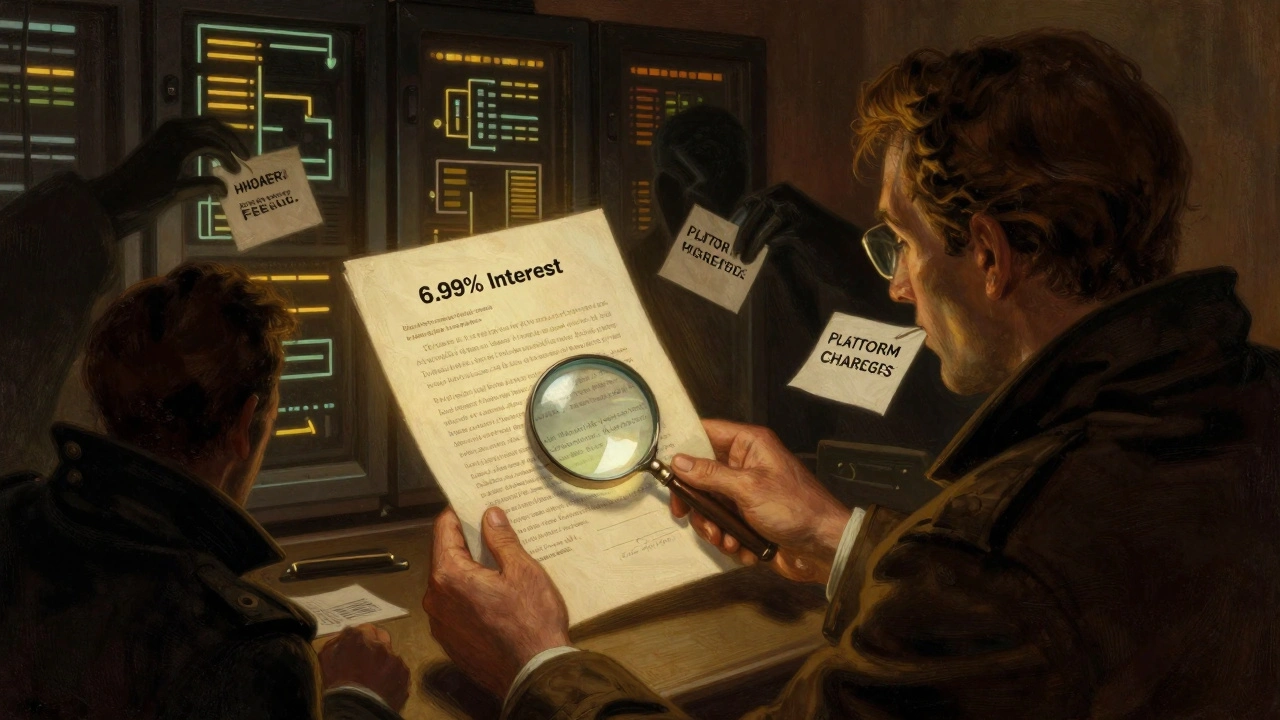
When you see a fintech loan advertised with a 6.99% interest rate, it’s easy to think you’re getting a great deal. But what if that 6.99% doesn’t tell the whole story? What if the real cost of your loan is closer to 9.5%-because of fees buried in the fine print? That’s where APR comes in. It’s not just a number on a screen. It’s the only number that tells you what you’re actually paying over a year, including every fee, charge, and hidden cost. And in fintech, where algorithms decide your rate in seconds, understanding APR isn’t just smart-it’s essential.
What APR Really Means (And Why It’s Not Just Interest)
APR stands for Annual Percentage Rate. It’s not the same as the interest rate. The interest rate is just the cost of borrowing the money. APR includes that interest plus all the other fees tied to the loan: origination fees, processing fees, platform charges, even data verification costs. If a lender charges a $300 fee on a $10,000 loan, that fee gets baked into the APR. That’s why a loan with a 7% interest rate and a $200 fee can have a 7.8% APR-and why you can’t trust the interest rate alone. The Truth in Lending Act of 1968 made APR mandatory in the U.S. to stop lenders from hiding costs. Today, the Consumer Financial Protection Bureau (CFPB) enforces it. But fintech lenders have found new ways to make APR confusing. Some hide fees behind multiple clicks. Others use “0% APR” promotions that still charge $45 in processing fees. When you annualize those fees, your real APR isn’t 0%-it’s 25% or more.The Math Behind APR: A Simple Formula That Tells the Truth
You don’t need to be a math expert to calculate APR. Here’s the basic formula used by the CFPB and most regulators:APR = (((Total Interest + Total Fees) ÷ Loan Amount) ÷ Number of Days in Loan Term) × 365 × 100
Let’s say you take out a $5,000 personal loan with a 12-month term. You’re told the interest rate is 8%. But there’s also a $150 origination fee and a $25 platform fee. Total fees = $175.Total interest over 12 months: $200 (based on 8% on $5,000)
Total fees: $175
Total cost: $375
Loan amount: $5,000
Term: 365 days
APR = (($375 ÷ $5,000) ÷ 365) × 365 × 100 = 7.5%
Wait-that’s lower than the interest rate? That can’t be right. Actually, it’s because we didn’t account for the fact that you’re paying the loan back monthly, not all at once. The correct method uses a more precise formula that accounts for payment timing. But for quick comparison, here’s a simpler rule of thumb:If fees are more than 1% of the loan amount, expect the APR to be at least 0.5-1.5% higher than the interest rate.
For a $10,000 loan with $200 in fees (2%), the APR will likely be 1-2% above the stated rate. That’s not small change. Over five years, that difference can cost you thousands.How Fintech Loans Twist APR: Dynamic Rates and Hidden Fees
Traditional banks use fixed rates. Fintech lenders use dynamic APRs. That means your rate can change after you apply-based on your phone usage, social media activity, or even how fast you type your name on the application. Upstart, for example, uses over 1,600 data points to adjust APRs. In 2023, they reported that 81% of borrowers got lower rates than they would from a bank. But here’s the catch: the rate you see at the start isn’t the rate you get at the end. And then there are the fees. Fintech lenders often add fees you won’t find in a bank loan:- Digital processing fee: 0.5-1.5% of loan amount
- Platform service charge: $30-$75 flat fee
- Data verification fee: $10-$25
- Early repayment penalty: 1-3% of remaining balance
Buy Now, Pay Later: The APR Trap
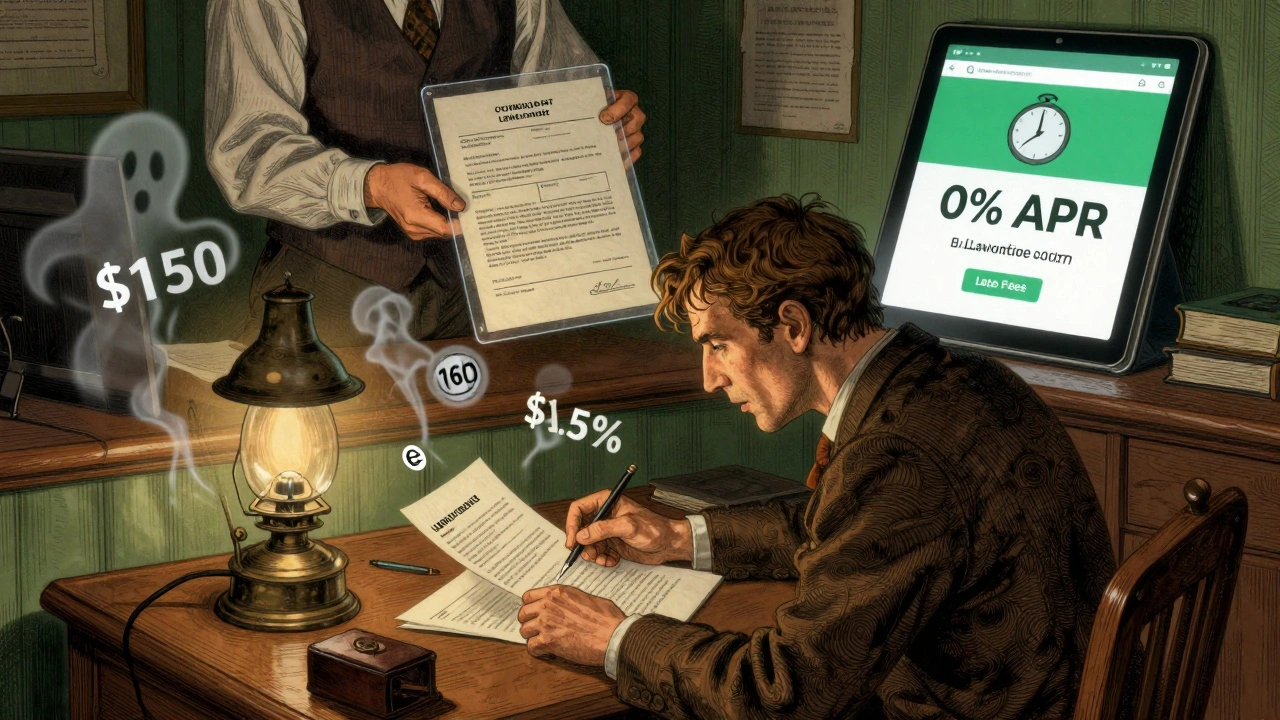
“0% APR” sounds amazing. Until you realize it’s only for 30 days. Miss a payment? You’re hit with a late fee-say, $35. Then another $35 next month. If you carry the balance for a year, that’s $420 in fees on a $500 purchase. Annualized, that’s an 84% APR. The CFPB fined Afterpay $15 million in 2022 for exactly this. Klarna, Affirm, and Klarna-style services often advertise “no interest” but charge fees that, when annualized, turn into double-digit APRs. In a Reddit thread from late 2023, over 300 users shared stories of discovering their “0% APR” BNPL loan had an effective APR of 28-35% after fees. The lender didn’t lie-they just didn’t tell you the full cost until after you signed.APR vs. Traditional Loans: What’s Better?
Fintech loans aren’t inherently worse. Sometimes they’re better. SoFi offers personal loans with clear, all-in APRs. Their website shows you the interest rate, the fee, and the total APR upfront. No hidden screens. No surprises. But compare that to a traditional bank mortgage. A bank might advertise a 6.5% interest rate but add $4,000 in closing costs. The APR jumps to 6.8%. Fintech lenders like Better.com might offer a 6.2% rate but add a $1,500 tech fee. Their APR is 6.5%. So the fintech loan is cheaper. The difference isn’t fintech vs. bank. It’s transparency vs. obfuscation.| Loan Type | Interest Rate | Typical Fees | Estimated APR | Disclosure Clarity |
|---|---|---|---|---|
| Fintech Personal Loan (SoFi) | 7.99% | $0 origination fee | 7.99% | Clear, upfront |
| Fintech Personal Loan (LendingClub) | 6.99% | $199-$499 fee | 8.1-8.9% | Hidden after 3 screens |
| Traditional Bank Auto Loan | 5.5% | $500 documentation fee | 5.9% | Disclosed in contract |
| BNPL (Affirm/Klarna) | “0% APR” | $35 late fee × 12 months | 84%+ effective APR | Only visible after purchase |
How to Protect Yourself: 5 Steps to Avoid APR Traps
1. Ask for the full fee schedule. Don’t rely on what’s on the homepage. Demand a PDF or screen capture of every fee before you click “Accept.” 2. Calculate your own APR. Use the CFPB’s free online calculator. It’s simple: enter the loan amount, interest rate, total fees, and term. It does the math for you. 3. Watch for “0% APR”. If it’s a buy-now-pay-later deal, assume the real APR is 25-40% unless proven otherwise. Read the terms. Look for late fees, missed payment penalties, and reinstatement charges. 4. Compare APRs, not interest rates. Two loans with 7% interest can have APRs of 8.5% and 9.2%. The lower APR saves you money. 5. Check reviews for APR complaints. Look for reviews on Trustpilot or Reddit that say “I thought my rate was X, but it turned out to be Y.” If multiple people report this, walk away.
What’s Changing in 2025
New rules are coming. In March 2024, the Federal Reserve required fintech lenders to disclose the top five data points used to calculate your APR. If your rate was raised because you used your phone after midnight, they have to tell you. That’s a big step toward fairness. Blockchain verification systems are being tested by 17 major fintech lenders. In 2025, you might be able to scan a QR code on your loan offer and instantly verify the APR calculation on a public ledger. No more hidden fees. But until then, you’re still the best defense. Lenders want you to focus on the interest rate. They know most people don’t look beyond it. Don’t let them win.Frequently Asked Questions
Is APR always higher than the interest rate?
Not always, but almost always. If a loan has no fees, the APR and interest rate are the same. But almost all fintech loans have fees-origination, processing, platform charges. Those fees push the APR above the interest rate. If you see a loan with a lower APR than the interest rate, something’s wrong. Double-check the math or walk away.
Can I trust a fintech lender’s advertised APR?
Only if you’ve seen the full fee schedule and confirmed it includes every charge. Many fintech lenders advertise an APR that excludes mandatory fees. The CFPB found that 41% of fintech loan ads in 2023 left out key fees. Always verify the APR yourself using the CFPB’s calculator. If the lender won’t give you a complete list of fees, they’re hiding something.
What’s the difference between APR and EIR?
APR (Annual Percentage Rate) is the standardized U.S. calculation that includes interest and fees but doesn’t account for compounding. EIR (Effective Interest Rate) does include compounding-meaning how often interest is added to your balance. For most personal loans, APR is what matters because payments are monthly, not daily. EIR matters more for credit cards or loans with daily compounding. For comparing fintech loans, stick to APR.
Why do some fintech loans show 0% APR but still charge fees?
It’s a marketing trick. “0% APR” means no interest-if you pay on time. But fees are separate. A $50 processing fee on a $1,000 loan paid back in 6 months equals an effective APR of 20%. If you miss a payment, late fees can push that to 100% or higher. The lender isn’t lying-they’re just counting on you not reading the fine print. Always ask: “What’s the total cost if I pay on time?” Then calculate the APR yourself.
How do I know if a fintech loan is truly cheaper than a bank loan?
Compare the APRs-not the interest rates. Then compare the total repayment amount. A bank loan might have a 7.5% APR with a $500 fee. A fintech loan might have a 7.2% APR with a $100 fee. The fintech loan saves you $400 over five years. But if the fintech loan has a prepayment penalty, you lose that advantage if you pay early. Always ask: “What’s the total amount I’ll pay if I pay on time? What if I pay early? What if I miss one payment?” Get all three numbers.



Comments
Jonathan Turner
December 9, 2025Let me guess-you thought 6.99% was the deal of the century until you got hit with that $200 ‘processing fee’ you didn’t even see coming. Classic fintech bait-and-switch. They advertise like they’re saving you money, but really they’re just moving the scam from the back room to a pop-up modal. The CFPB’s been screaming about this since 2020, and yet here we are-people still clicking ‘Accept’ without reading a single line. You don’t need a degree in finance to spot this. You just need to stop trusting anyone who says ‘it’s automated.’
Geoffrey Trent
December 10, 2025Ugh. I just got a loan from one of these apps last month. Thought I was getting 7.5% APR. Turned out to be 9.3% after the ‘platform fee’ and ‘data verification charge’-both buried under ‘Terms & Conditions’ which required three clicks to even find. I didn’t even know those were a thing. Now I’m stuck paying $180 extra over the year because I was too lazy to read the fine print. Everyone’s in a rush these days. Nobody reads. And the lenders know it.
John Weninger
December 11, 2025I really appreciate this breakdown-it’s the kind of thing that should be taught in high school. I’ve seen friends get burned by BNPL ‘0% APR’ deals and not realize they’re paying 40%+ in hidden fees. The worst part? They feel ashamed, like it’s their fault for being ‘bad with money.’ But it’s not. It’s predatory design. If you’re making it hard to understand the cost, you’re not helping people-you’re exploiting them. Kudos for calling out the real issue: transparency, not just interest rates. Let’s push for mandatory plain-language disclosures. No more 5-screen deep fee traps.
Omar Lopez
December 12, 2025There is a fundamental error in your formulaic exposition. The APR calculation you provided-(((Total Interest + Total Fees) ÷ Loan Amount) ÷ Number of Days in Loan Term) × 365 × 100-is mathematically invalid for amortizing loans. It assumes linear amortization, which is only accurate for single-payment instruments. For monthly repayments, the correct methodology requires solving for the internal rate of return (IRR) via iterative methods, as codified in Appendix J of Regulation Z. The CFPB’s calculator uses Newton-Raphson approximation. Your ‘rule of thumb’ is dangerously reductive. If you’re going to educate, at least get the math right.
Graeme C
December 14, 2025So let me get this straight-fintechs are using your typing speed to decide your interest rate? That’s not finance, that’s dystopian surveillance capitalism dressed in a hoodie. And now they’re talking about blockchain verification? Please. If they wanted transparency, they’d just put the full fee schedule on the first page. Instead, they’re building a whole new layer of obfuscation just to make it look like they’re ‘fixing’ the problem. This isn’t innovation. It’s theater. And we’re all just sitting in the audience, clapping while they steal our money.
Write a comment