Fee Impact Calculator
Comparison of Investment Growth
When you hire a financial advisor, you expect them to put your interests first. But what if their pay depends on the products they push? That’s not a rare exception-it’s the norm in many parts of the industry. Advisor conflicts of interest aren’t just theoretical. They’re built into how mutual funds are sold, how advisors get paid, and which share classes get recommended. And you’re the one paying for it-often without knowing.
How 12b-1 Fees Work (And Why They’re a Problem)
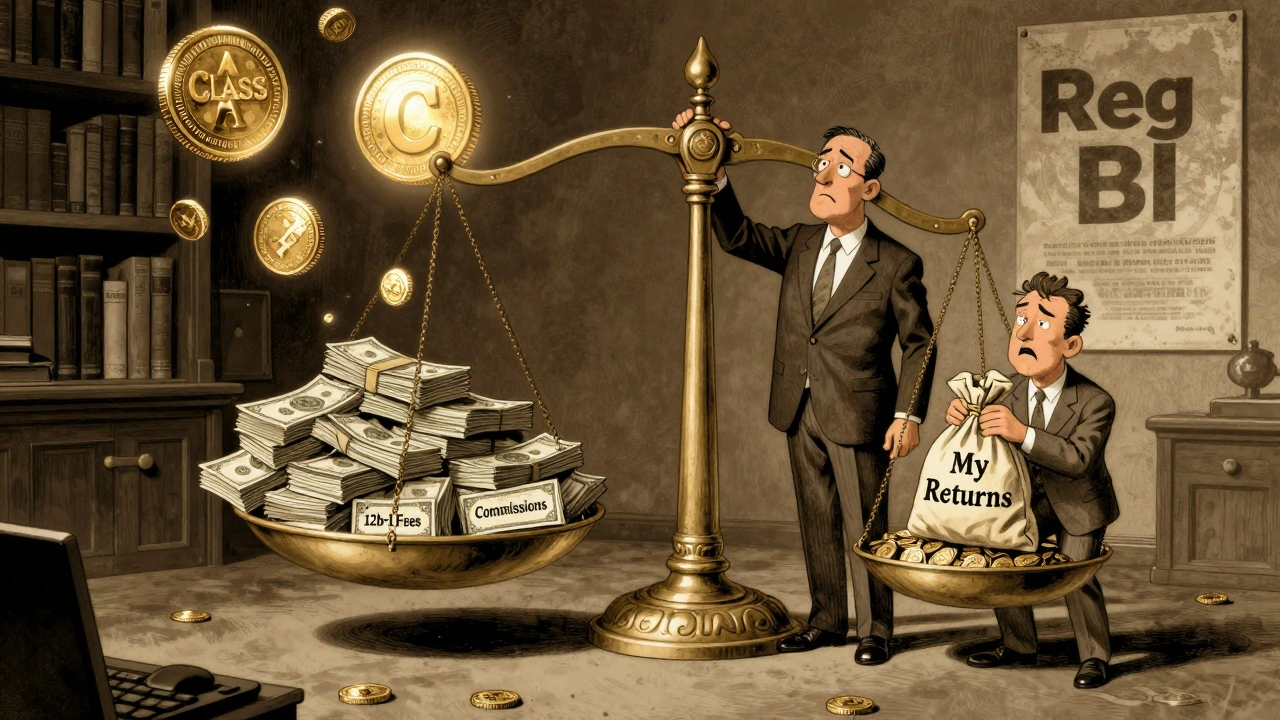
12b-1 fees are annual charges built into some mutual funds. They’re meant to cover marketing and distribution costs. But here’s the twist: these fees go straight to your advisor-or the firm they work for-every year you hold the fund. The SEC allows up to 0.75% for distribution and another 0.25% for shareholder services, totaling 1%. In practice, many Class C shares charge the full 1% every single year.
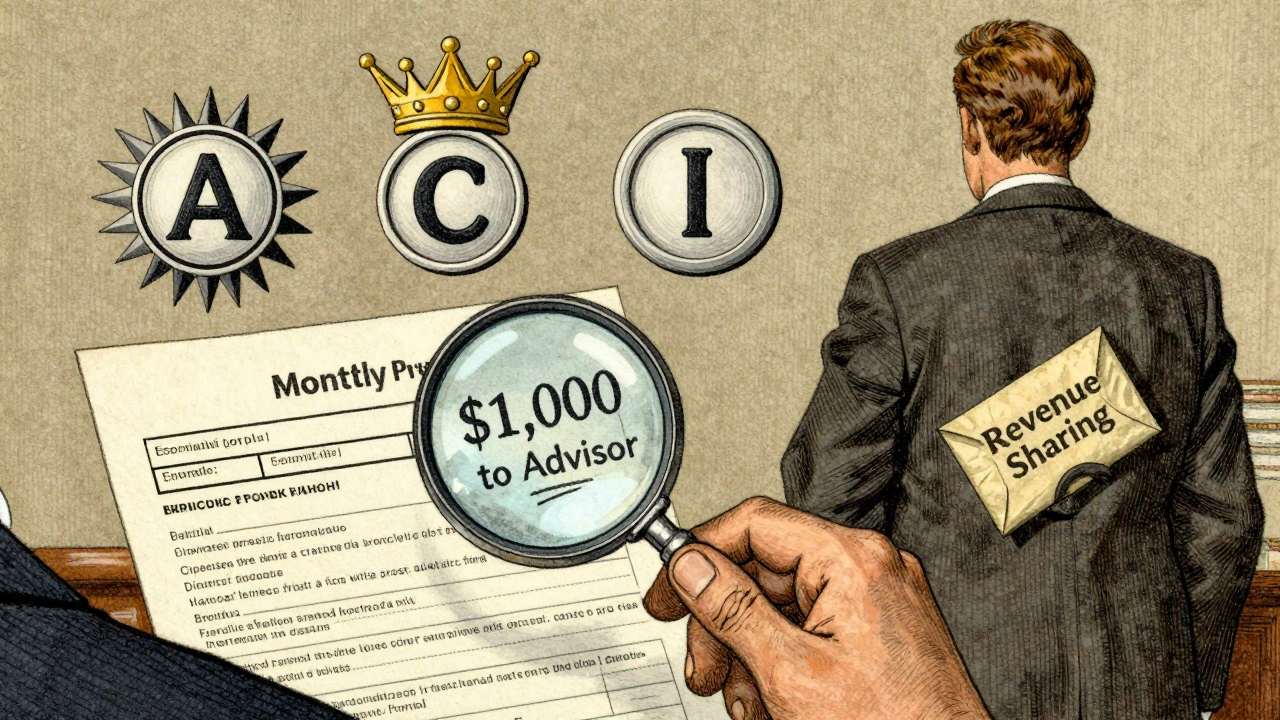
That means if you invest $100,000, your advisor could be earning $1,000 a year just for keeping you in that fund. And you don’t see it as a separate bill. It’s hidden inside the fund’s expense ratio. You think you’re paying 0.8% for management. But 1% of that is going to your advisor. That’s not a fee you negotiate. It’s a commission disguised as an expense.
The SEC called this out in 2019. One adviser told clients they "might" receive extra compensation. But the truth? They were getting 12b-1 fees on every recommendation. That’s not disclosure. That’s deception. The SEC fined them. But they didn’t stop the practice.
Share Classes: The Same Fund, Different Price Tags
Ever notice how the same mutual fund has multiple versions? That’s because fund companies create different share classes to match different payment models.
- Class A shares charge a front-end load-sometimes up to 5.75%-when you buy. That’s a big upfront cost, but ongoing fees are lower. These are often pushed for long-term investors.
- Class C shares have no front-end load, but charge that full 1% 12b-1 fee every year. They also usually have higher expense ratios. These are perfect for advisors who want to earn commissions every year, not just once.
- Class I or Institutional shares have no sales loads and minimal fees-often under 0.5%. But you usually can’t buy them unless you have $1 million or more. Or unless your advisor works for a firm that offers them to retail clients.
Here’s the real kicker: the underlying investments in Class A, Class C, and Class I of the same fund are identical. Same stocks. Same manager. Same performance. But the fees? Totally different.
So why would your advisor recommend Class C over Class I? Because Class C pays them 1% a year. Class I pays them nothing. And if they’re paid on commission, not salary, that’s the only math that matters.
How Advisors Get Paid (And What It Means for You)
There are three main ways advisors earn money from mutual funds:
- Commissions - One-time payment when you buy a fund. Common with Class A shares.
- 12b-1 fees - Annual payments for keeping you in the fund. Common with Class C shares.
- Revenue sharing - The fund company pays the advisor’s firm a kickback to include their fund in preferred lists or retirement platforms.
Edward Jones, one of the largest broker-dealers, openly admits this in their 2023 disclosure: "Your financial advisor’s branch P&L is positively impacted by compensation received from client activities, including commissions, sales charges, 12b-1 fees."
That’s not a footnote. That’s their business model. And it’s legal. But it’s not aligned with your best interest.
Fee-only advisors don’t earn commissions. They charge you a flat percentage of your assets-usually 0.5% to 1% a year. They’re not pushing specific funds. They’re building portfolios. That’s why they’re more likely to use low-cost index funds or institutional share classes. They have no incentive to pick the fund with the highest 12b-1 fee.
The SEC’s Fight (And Why It’s Not Enough)
In 2016, the SEC launched the Share Class Selection Disclosure (SCSD) Initiative. It was a chance for advisors to self-report recommending higher-fee share classes when lower-cost options existed. Over 95 firms came forward. They paid back $140 million to clients.
But here’s what happened next: after April 2020, the SEC stopped accepting voluntary disclosures. From then on, violators faced not just repayment-but civil penalties. That’s when the crackdown got real. In 2022 alone, the SEC filed 27 enforcement actions against advisors for undisclosed conflicts.
Regulation Best Interest (Reg BI), introduced in 2020, was supposed to fix this. It requires advisors to act in your best interest. But it doesn’t ban commissions. It doesn’t require full dollar disclosures. It doesn’t even define "best interest" clearly. So advisors still recommend funds that pay them more-even when cheaper options are available.
As the CFA Institute put it: Reg BI doesn’t stop conflicts. It just asks advisors to claim they managed them. And too often, they don’t.

How to Protect Yourself
You can’t control what your advisor earns. But you can control what you ask for.
- Ask for Form ADV Part 2. This is the advisor’s official disclosure document. Look for sections on compensation, conflicts, and disciplinary history. If it’s vague, push for details.
- Ask: "Do you earn commissions from the funds you recommend? If so, which ones?" If they hesitate, walk away.
- Check your account statements. Look for "12b-1 fees," "sales loads," or "distribution fees." If you see them, ask why you’re paying them instead of a lower-cost version.
- Compare total costs. Add up your advisor’s fee, the fund’s expense ratio, and any 12b-1 fees. If it’s over 1.5%, you’re likely overpaying. Most index portfolios cost under 0.3%.
- Ask if lower-cost share classes are available. If they say no, ask why. If they say "you don’t qualify," ask for proof. Institutional shares aren’t just for millionaires anymore-some firms offer them to all clients.
Don’t rely on trust. Rely on transparency. If your advisor can’t tell you exactly how much they’re earning from your investments, they’re not working for you.
What’s Next? The Industry Is Changing-Slowly
More firms are moving toward fee-only models. More clients are asking questions. And the SEC keeps enforcing. But 12b-1 fees still exist. Commissions still drive recommendations. And most investors still don’t know they’re paying them.
Some experts think the SEC will eventually ban 12b-1 fees entirely. Others think they’ll cap them or restrict their use in retirement accounts. But until then, the burden is on you.
The system is rigged to reward advisors who push high-fee products. You don’t have to be part of it. You just have to ask the right questions-and walk away if the answers don’t add up.
Are 12b-1 fees legal?
Yes, 12b-1 fees are legal under SEC Rule 12b-1, which permits mutual funds to use up to 1% of assets annually for distribution and servicing. But using them to incentivize advisors to recommend higher-cost share classes over lower-cost alternatives is a conflict of interest-and the SEC has fined dozens of firms for failing to disclose this properly.
Can I avoid 12b-1 fees entirely?
Yes. Choose funds with no sales loads and no 12b-1 fees-typically Class I, Class Y, or institutional shares. Many ETFs and index funds also have zero 12b-1 fees. Ask your advisor if lower-cost share classes are available for the same fund. If they say no, they may be limiting your options to protect their commission.
What’s the difference between a fee-only and a commission-based advisor?
A fee-only advisor charges you a flat percentage of your assets (like 0.75% per year) and doesn’t earn commissions from products you buy. A commission-based advisor earns money every time you buy or sell a fund, insurance product, or annuity. That creates a direct conflict: their income grows when you trade more or choose higher-fee products.
How do I know if my advisor is pushing me into a high-fee fund?
Compare the fund’s expense ratio and 12b-1 fees to identical funds with different share classes. If your advisor recommends a Class C fund with a 1% 12b-1 fee when a Class I version of the same fund exists with no such fee, that’s a red flag. Ask why you’re not getting the cheaper version. If they can’t give a clear, cost-based answer, they’re likely prioritizing their compensation.
Should I switch to a fee-only advisor?
If you’re paying more than 1.5% in combined fees (advisory + fund expenses + commissions), switching to a fee-only advisor could save you thousands over time. Fee-only advisors typically charge 0.5%-1% and use low-cost index funds, reducing your total cost to under 1%. That’s not just better for your portfolio-it’s better for your peace of mind.




Comments
Jonathan Turner
December 9, 2025Oh wow, a financial advisor who actually admits they’re getting paid to screw you over? Groundbreaking. I didn’t realize Edward Jones was running a charity. Next they’ll tell us the moon landing was faked too. 12b-1 fees? More like 12b-1 ‘fuck you’ fees. And don’t get me started on Class C shares-those are just the financial equivalent of a car salesman sliding you into a lease with ‘no money down’ while charging you 18% interest. The SEC ‘crackdown’? Please. They fine a few firms, let them pay back pennies on the dollar, and then go back to napping while the rest of the industry laughs all the way to the bank. You think this is broken? Nah. It’s working exactly as designed.
Geoffrey Trent
December 11, 2025Same old story. People act like this is some secret conspiracy, but it’s not. It’s capitalism. Advisors get paid because someone has to pay them. If you don’t want to pay 1% a year, go buy ETFs on Robinhood and call it a day. Stop pretending you’re some victim of a rigged system-you’re just too lazy to do your own research. I’ve been doing my own investing for 12 years and never paid a dime to an advisor. You think your ‘fee-only’ guy is any better? He’s just charging you 1% to tell you to buy VTI and VOO. That’s it. No magic. No insight. Just a fancy title and a LinkedIn post about ‘financial freedom.’
John Weninger
December 12, 2025I’ve been on both sides of this. I used to work with commission-based advisors and thought they were helping me-until I started digging into my statements. That’s when I realized I was paying twice: once for the advice, and again through hidden fees I didn’t even know existed. I switched to a fee-only advisor who uses institutional shares, and my portfolio’s grown 30% more in three years than it did in the previous five. It’s not about being rich-it’s about being informed. If you’re reading this and wondering if you’re being taken advantage of, you probably are. But you’re not alone. And you don’t have to stay that way. Ask the questions. Demand transparency. It’s not about trusting your advisor-it’s about trusting yourself enough to ask for the truth. You’ve got this.
Omar Lopez
December 13, 2025The SEC’s Regulation Best Interest is a semantic sleight-of-hand designed to absolve fiduciary duty while maintaining the status quo. The term 'best interest' remains deliberately undefined, permitting advisors to rationalize recommendations that maximize compensation under the guise of compliance. Institutional share classes are not restricted by wealth per se, but by distribution agreements-firms deliberately exclude retail clients to preserve commission streams. Form ADV Part 2 is not merely a document; it is the only legally binding disclosure mechanism available to the retail investor. Failure to interrogate it constitutes negligence. The burden of proof has been illegitimately shifted from the advisor to the client. This is not market efficiency. It is regulatory capture dressed in compliance jargon.
Write a comment