International Fund Allocation Calculator
Calculate Your Allocation
Determine the ideal split between developed and emerging markets based on your risk tolerance and investment goals.
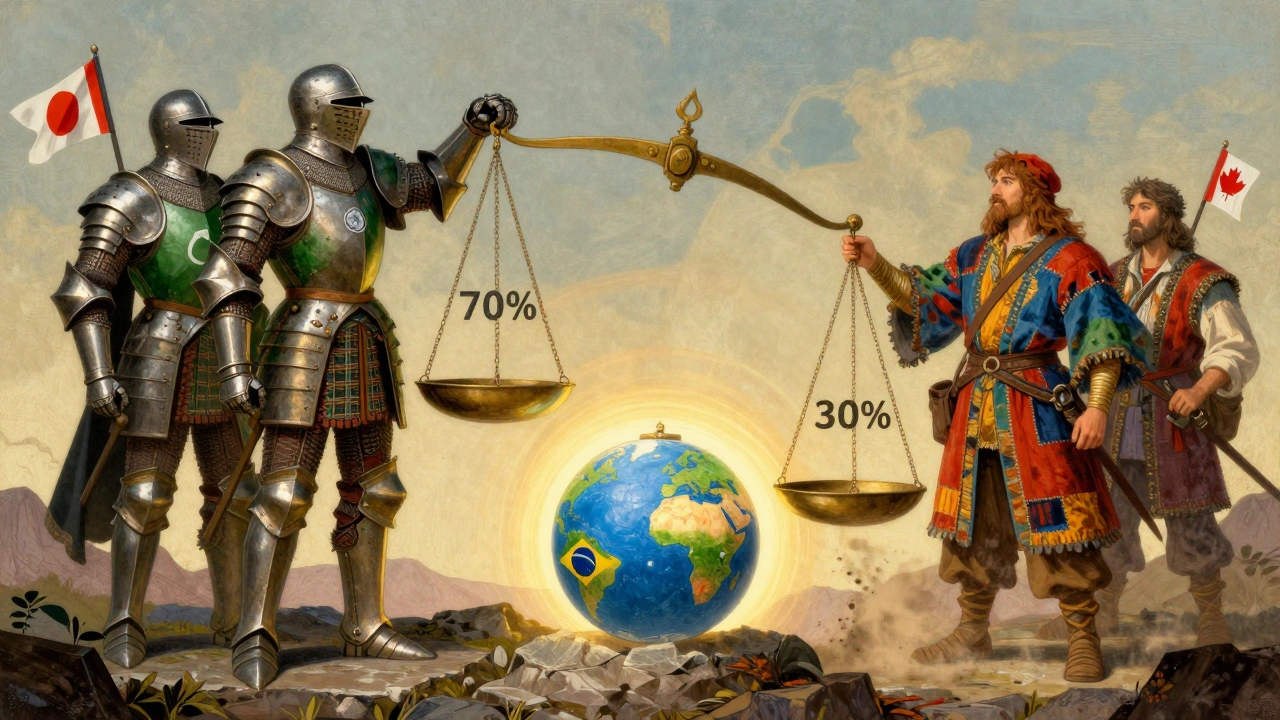
When you invest in international index funds, you're not just buying foreign stocks-you're betting on entire economies. But not all foreign economies are created equal. The split between developed markets and emerging markets in your portfolio can make a huge difference in risk, return, and how your investments behave during market swings. So how much should you have in each? And why do some funds give you 70% in developed countries while others push 30% or more into emerging ones?
What Counts as Developed vs Emerging Markets?
The line between developed and emerging markets isn’t just about how rich a country is. It’s about how stable, transparent, and liquid its stock market is. MSCI, the biggest index provider, defines developed markets as countries with mature financial systems, strong legal protections for investors, and deep trading volumes. Think Japan, Germany, Canada, Australia. These are places where you can buy or sell millions of shares in a day without moving the price much. Emerging markets are different. They’re growing fast-India, Brazil, Vietnam, Saudi Arabia-but their markets are less predictable. Liquidity is thinner, regulations are still evolving, and political risks are higher. China alone makes up over 30% of the entire emerging markets index. That’s more than the next three largest EM countries combined. So when China’s stock market drops 15%, your entire emerging markets fund feels it. The tricky part? Classification isn’t universal. South Korea is considered developed by MSCI but emerging by FTSE. That one difference alone can shift your portfolio’s exposure by 2-3% just because you picked one fund over another. If you’re using multiple funds from different providers, you might accidentally overweight or underweight certain countries without even realizing it.Typical Weight Allocations: 70/30 Is the Norm
Most major international index funds follow a rough 70/30 split: 70% in developed markets, 30% in emerging markets. Vanguard’s total international fund (VGTSX), iShares’ IEMG, and Schwab’s SCHF all hover around this range. Why? Because it mirrors global market capitalization. Developed markets still control about 75% of the world’s public equity value outside the U.S. Emerging markets make up the rest. But here’s the catch: market cap doesn’t always equal smart allocation. Ray Dalio, founder of Bridgewater Associates, argues that emerging markets should be closer to 30% of your global portfolio-not just because they’re big, but because they’re less correlated with U.S. stocks. When the U.S. market tanks, emerging markets don’t always follow. That’s the diversification magic he calls the "Holy Grail of Investing." Morningstar’s research backs this up. Their analysts found that portfolios with 25-30% in emerging markets delivered the best risk-adjusted returns over full market cycles. Too little (under 20%) and you miss out on growth. Too much (over 35%) and you get crushed during dollar surges or global sell-offs.Why Emerging Markets Are More Volatile-And Why That Matters
In 2022, the U.S. dollar jumped 12% against most global currencies. Emerging markets got hammered. China’s regulatory crackdowns, Russia’s invasion of Ukraine, and India’s political uncertainty all piled on. The iShares MSCI Emerging Markets ETF (IEMG) dropped 35%. Meanwhile, the developed markets fund (IDEV) fell only 20%. That’s not a fluke. It happens every time the dollar strengthens. Why? Because emerging market companies earn revenue in local currencies but often owe debt in U.S. dollars. When the dollar rises, their costs go up, profits shrink, and investors flee. Developed markets, with their stronger currencies and more stable economies, handle dollar spikes better. But here’s the flip side: when the dollar weakens, emerging markets explode. In 2023, after the dollar cooled off, many EM funds returned over 25%-far outpacing developed markets. That’s why investors who stick with 25-30% EM exposure don’t try to time the market. They ride the waves.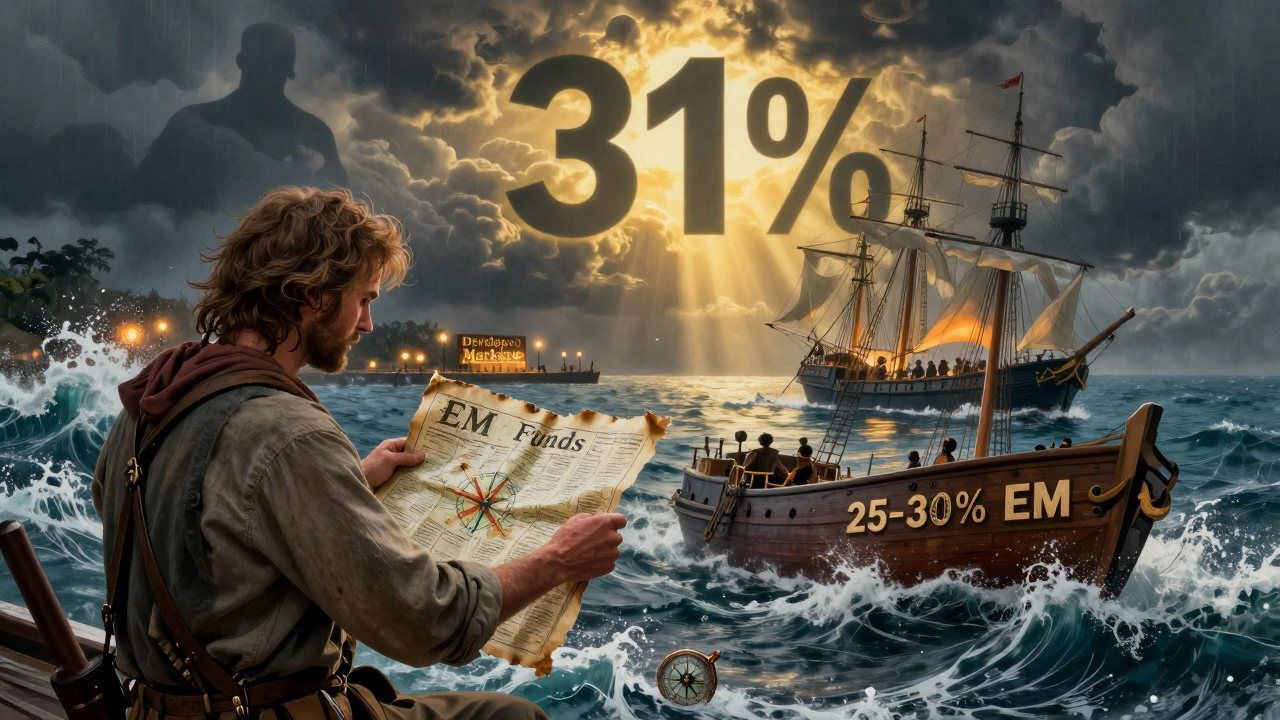
Fund Differences: Small Caps, Coverage, and Costs
Not all emerging markets funds are the same. Vanguard’s VWO tracks the FTSE Emerging Markets Index, which only includes large and mid-cap stocks. iShares’ EMIM uses the MSCI Emerging Markets IMI Index, which adds small-cap companies. That means EMIM gives you about 8-12% more exposure to smaller, faster-growing firms-companies that historically deliver higher returns over time, but with more volatility. Costs matter too. VWO charges 0.22% in fees. EMIM? Just 0.18%. That might not sound like much, but over 20 years, that 0.04% difference can save you thousands. And while both have Morningstar Gold ratings, EMIM has over $16 billion in assets, making it the most liquid EM fund on the market. That means tighter spreads and easier trading if you ever need to sell. For developed markets, Vanguard’s VEA (0.03%) is the cheapest and most popular. But if you want to avoid U.S. exposure entirely, you’ll need MSCI EAFE-based funds like iShares’ IDEV. The EAFE index covers Europe, Australia, and Asia-excluding the U.S.-and makes up the bulk of international portfolios for investors who want pure foreign exposure.The China Problem
China is the elephant in the room. Right now, it’s 31% of the emerging markets index. That’s more than Taiwan, India, and South Korea combined. If China’s economy slows, or if U.S.-China tensions escalate, your EM fund takes a direct hit. Some experts think this is too much. BlackRock’s research says reducing China’s weight below 20% would require either rebalancing (which increases tracking error) or switching to equal-weighted or factor-based strategies. That’s why newer funds are starting to experiment. iShares now offers EIMM, a low-volatility EM ETF that reduces exposure to the most volatile stocks-including some Chinese firms. Vanguard announced in late 2023 it will adjust its EM index to align with MSCI’s new three-tier system, which will likely cut China’s weight to around 24-26% by 2025. By 2027, most index providers plan to replace the simple "developed vs emerging" split with four categories: Developed, Advanced EM (China, India, Taiwan), Secondary EM, and Frontier Markets. India is expected to move into Advanced EM by 2026. That means your EM allocation won’t just be "emerging" anymore-it’ll be broken down by growth stage.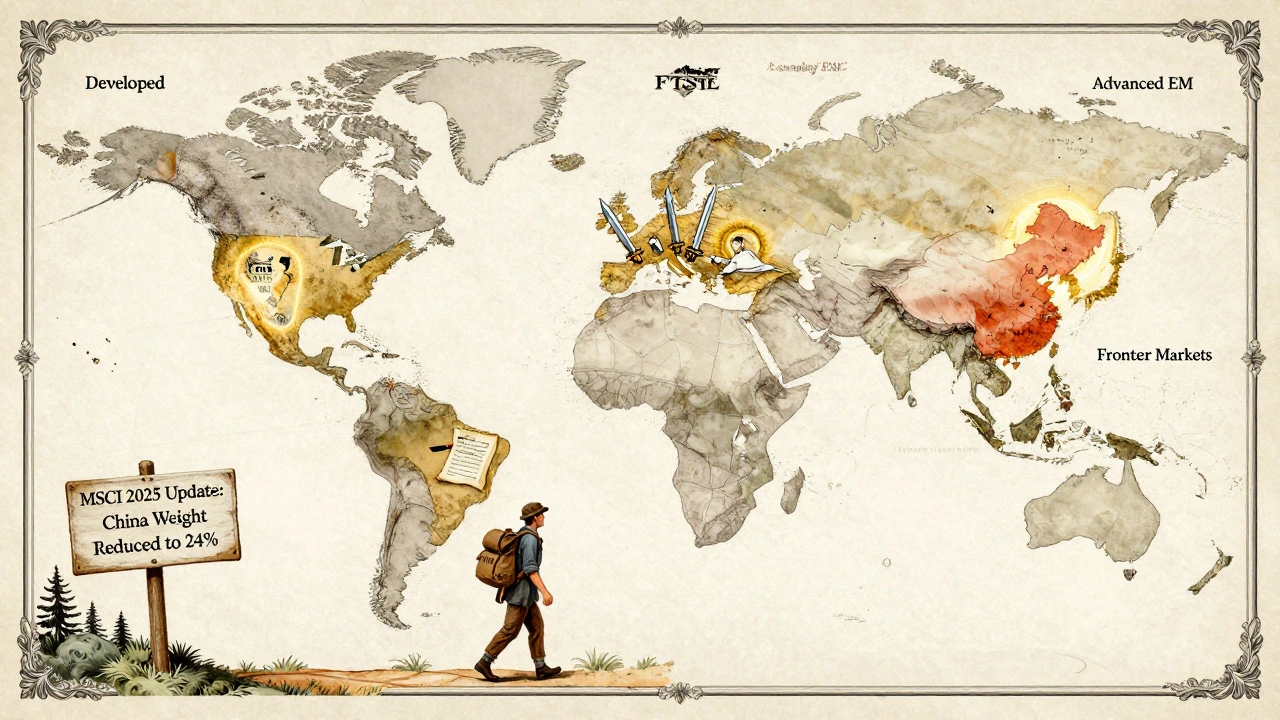
How to Build Your Allocation
If you’re starting out, the easiest way is to use a single fund that does the work for you. Vanguard’s Total International Stock Index Fund (VGTSX) automatically holds 72% developed and 28% emerging markets. You don’t need to think about it. If you prefer to build your own, here’s a simple approach:- Use VEA (developed markets) and VWO (emerging markets) together to stay within the same provider’s system.
- Set your split at 70/30 or 75/25 based on your risk tolerance.
- Avoid mixing MSCI and FTSE funds unless you’re prepared to manually adjust for double-counting.
- Don’t hedge currency exposure unless you’re a professional. Studies show hedging reduces long-term returns by 0.4-0.7% annually.
- Check MSCI’s annual classification updates every June-they change country status regularly.
Common Mistakes to Avoid
Most investors mess up international exposure in three ways:- Double-counting the U.S. If you own VT (Vanguard Total World Stock), you already have U.S. exposure. Adding a U.S.-focused fund like VTI on top means you’re overweighting America. About 28% of new investors make this mistake.
- Chasing performance. EM funds surged in 2023. Many investors piled in. Then China stalled. By late 2024, those who bought high were stuck. Stick to your plan.
- Ignoring fees. A 0.65% fee on an emerging markets fund (like SEDY) eats away your returns. Stick to funds under 0.25%.
Where Is This All Headed?
The future of international investing isn’t about developed vs emerging. It’s about granular segmentation. By 2026, you’ll see funds that separate India from China, or Vietnam from Egypt. Factor-based strategies-like low-volatility or dividend-focused EM ETFs-are growing fast. BlackRock’s EIMM has hit $1.2 billion in assets because it reduces the emotional rollercoaster of EM investing. For most people, the best move is simple: hold a low-cost, broadly diversified international fund with around 25-30% in emerging markets. Don’t overthink it. Don’t chase trends. Let the market do the work.International index funds aren’t about predicting the next China boom or avoiding the next dollar surge. They’re about spreading your risk across economies that don’t move in lockstep. That’s the real advantage-and it’s why even a modest 30% allocation can make your portfolio stronger over time.
What’s the ideal percentage of emerging markets in an international fund?
Most experts recommend 25-30% emerging markets in your international allocation. This balances growth potential with risk. Morningstar’s research shows this range delivers the best risk-adjusted returns over full market cycles. Going below 20% misses out on diversification benefits; above 35% increases volatility too much for most investors.
Why is China such a big part of emerging markets funds?
China makes up about 31% of the MSCI Emerging Markets Index because it has the largest stock market by market cap in the emerging world-larger than the next three countries combined. Its size reflects its economic weight, but it also creates risk. If China’s market drops, your entire EM fund suffers. Index providers like MSCI and Vanguard are planning to reduce China’s weight by 2025 to improve diversification.
Should I use one fund or two for international exposure?
For most investors, one fund is better. A total international fund like Vanguard’s VGTSX automatically handles the developed/emerging split. If you use two funds (like VEA and VWO), stick to the same provider to avoid classification mismatches. Mixing MSCI and FTSE funds can lead to unintended overweighting or underweighting of countries like South Korea.
Are emerging markets funds riskier than developed markets funds?
Yes, significantly. Emerging markets are more volatile due to political instability, currency swings, and less liquid markets. In 2022, EM funds dropped 35% while developed markets fell 20%. But they also rebound harder-EM funds returned over 25% in 2023. The key is staying invested through cycles, not trying to time them.
Do I need to hedge currency risk in international funds?
No, not for long-term investors. Currency hedging reduces short-term volatility but cuts long-term returns by 0.4-0.7% per year, according to Yale University’s research. Over 20 years, that adds up to tens of thousands in lost growth. Most advisors recommend unhedged exposure for buy-and-hold investors.
What’s the difference between MSCI and FTSE emerging markets indexes?
MSCI’s EM IMI index includes small-cap stocks, giving you 8-12% more exposure to smaller companies that historically grow faster. FTSE’s index only covers large and mid-caps. MSCI also classifies South Korea as developed; FTSE calls it emerging. That single difference can shift your portfolio by 2-3%. Always check which index your fund tracks.






Comments
Kenny McMiller
December 4, 2025Look, the 70/30 split isn't magic-it's just the market cap weighting catching up to reality. But here's the kicker: if you're not accounting for the fact that emerging markets are essentially the world's last uncorrelated alpha engine, you're leaving free money on the table. Ray Dalio's right-this isn't about chasing growth, it's about systemic diversification. When the U.S. gets its ass handed to it by inflation or a Fed misstep, EMs don't just lag-they often diverge. That’s not noise, that’s portfolio insurance. And yeah, China’s a beast, but so is India’s retail-driven tech surge. The real play? Accept the volatility, don’t hedge currency (studies show it’s a tax on returns), and let the compounding do the heavy lifting. You’re not betting on countries-you’re betting on entropy in financial systems. And entropy favors diversification.
Dave McPherson
December 6, 2025Ugh, another ‘70/30’ drone. You people treat index funds like yoga poses-‘just breathe and trust the algorithm.’ Newsflash: MSCI is a private firm with a profit motive, not some oracle. South Korea being ‘developed’? That’s like calling a Tesla Model 3 a luxury sedan because it has leather seats. Meanwhile, India’s markets are run by guys who still use fax machines to confirm trades. And don’t even get me started on ETFs with 0.22% fees-like that’s some kind of discount. I’ve got a 0.07% fund that tracks the same damn index with half the turnover. If you’re not screaming about tracking error, you’re not investing-you’re just giving your money to Wall Street’s new religion: passive compliance.
RAHUL KUSHWAHA
December 8, 2025India’s EM weight is gonna jump soon-probably past 15% by 2026. That’s good. But I’ve seen too many foreigners treat EM like a lottery ticket. We have great companies, sure. But the bureaucracy? The stock settlement delays? The sudden tax changes? It’s not just risk-it’s patience. I use VWO because it’s simple. No hedging. No tinkering. Just hold. And yes, when China drops 15%, my stomach drops too. But I’ve learned: if you can’t sleep when the market’s down, you own too much. 28% is enough. More than that? You’re speculating, not investing. 🙏
Julia Czinna
December 9, 2025Thank you for writing this with such clarity. I’ve been confused for years about why some funds call South Korea developed and others don’t-it’s maddening. I switched from an FTSE-based fund to Vanguard’s total international last year after realizing I was accidentally overweighting Korea and underweighting Saudi Arabia. The 28% EM allocation has held up beautifully through the dollar swings. I don’t chase returns, and I don’t hedge currency. I just check the MSCI rebalancing every June and remind myself: this isn’t about predicting the future. It’s about not being destroyed by it. Also, Dave? You’re not wrong about the fees, but don’t let perfectionism paralyze you. A 0.22% fund that’s liquid and well-managed beats a 0.07% fund that’s illiquid and poorly tracked any day. Consistency > cleverness.
Write a comment